Multiplanar Fabric AI Networking Primer
Reference architecture and design diagrams for MRC (Multipath Reliable Connection) networking — the OCP-standard approach to scaling AI training clusters over deterministic, multi-plane Ethernet fabrics.
MRC replaces traditional InfiniBand-style fat-tree designs with eight fully independent fabric planes, static SRv6 source routing, and NIC-driven path selection. The result is predictable, high-bandwidth inter-node communication for distributed training workloads without ECMP, dynamic routing, or application changes.
What is MRC?
Multipath Reliable Connection (MRC) is defined in OCP MRC Rev 1.0 and targets large-scale GPU clusters where collective operations (all-reduce, all-gather) dominate inter-node traffic.
| Principle | Description |
|---|---|
| Eight independent planes | Each plane is a dedicated leaf–spine pair with no cross-plane links. Traffic on plane n never traverses plane m. |
| NIC-to-plane wiring | NIC n on every node connects to the leaf switch of plane n. This discipline is the foundation of the entire design. |
| Static SRv6 routing | Paths are encoded in an SRv6 uN uSID stack at the destination address. Switches perform deterministic uSID shifts — no BGP, no ECMP. |
| 32-bit Entropy Value (EV) | A per-packet identifier striped across the IPv6 flow label and UDP source port. EVs are generated at QP startup (128–256 per QP, split across planes) and echoed in SACK/NACK feedback for path health monitoring. |
| Lossy Ethernet RDMA | PFC is disabled. The MRC engine in the SmartNIC handles retransmission and congestion response at the transport layer. |
At the node level, intra-node traffic (NVLink on Nvidia, Infinity Fabric on AMD) handles local all-reduce, while inter-node traffic flows through MRC-capable SmartNICs over the eight-plane fabric.
Glossary
Unfamiliar with uN, PSP, FRR, EV, or other terms in these pages? See the Glossary — definitions for MRC transport, SRv6 uSID micro-behaviors, behavior flavors, SONiC stack components, and fabric acronyms.
Documentation map
Protocol & packet format
Understand how MRC encodes paths and entropy in every packet.
- MRC Packet Structure — SRv6 + Entropy Value — IPv6-in-IPv6 encapsulation, outer SRv6 uN uSID stack, 32-bit EV placement, and the role of EV in SACK/NACK feedback (not forwarding).
- SRv6 uN uSID — Leaf/Spine Config (SONiC vs Arista) — Side-by-side SONiC and Arista EOS 4.36 programming model, F3216 addressing plan, and concrete leaf/spine templates for MRC static fabrics.
- MRC Packet Spray Animation — Interactive simulation of per-packet EV spray across eight planes, with congestion, trimming, failure, and NACK re-steering.
Node-level integration
How individual compute nodes connect GPUs to the eight-plane fabric.
- AMD MI350X — MRC SRv6 Fabric Connectivity — AMD Instinct MI350X with Pensando Pollara 400 NICs (AMD's OCP MRC Rev 1.0 reference platform); ibverbs shim via RCCL; AMD vs Nvidia node comparison on the same fabric.
- Nvidia HGX Blackwell (B300) — NVLink/NVSwitch for intra-node all-reduce; ConnectX-8 SuperNICs for inter-node MRC at 8 × 800G (6.4 Tbps per node). ConnectX-8 SuperNIC is Nvidia's OCP MRC Rev 1.0 reference platform — ConnectX-7 is not MRC-capable.
Vendor-agnostic fabric
MRC is fabric-agnostic. Both Nvidia and AMD nodes implement the same OCP MRC Rev 1.0 semantics — identical EV generation, SRv6 forwarding, and plane wiring. An Arista 7060XE7 switch sees indistinguishable traffic from either vendor, making mixed AMD + Nvidia clusters architecturally valid.
Rack & data center deployments
End-to-end rack layouts pairing compute with MRC fabric switches.
- 72-GPU Blackwell Ultra MRC Rack — Arista 7060XE7 + Nvidia HGX B300 — Reference rack: 9 × HGX B300, ConnectX-8 SuperNIC (Nvidia's OCP MRC Rev 1.0 reference NIC) at 800G per uplink; GPU/switch SKUs differ from paper Table 1.
- GB300 NVL72 — Liquid-Cooled Data Center Rack — Reference 48U MGX rack (72 × B300, CDU, 135 kW TDP); MRC fabric uses CX-8 — rack form factor not validated end-to-end in the OpenAI paper.
Key design parameters
| Parameter | Nvidia (Blackwell) | AMD (MI350X) |
|---|---|---|
| NIC | ConnectX-8 SuperNIC | Pollara 400 |
| OCP MRC Rev 1.0 reference NIC | Nvidia reference platform | AMD reference platform |
| Uplink speed | 800G per plane | 400G per plane |
| NICs per node | 8 | 8 |
| Fabric BW per node | 6.4 Tbps | 3.2 Tbps |
| Leaf/spine switch | Arista 7060XE7 | Arista 7060XE7 |
| Planes | 8 (independent) | 8 (independent) |
| Routing | SRv6 uN uSID (static) | SRv6 uN uSID (static) |
| EVs per QP | 128–256 | 128–256 |
| ECMP / dynamic routing | Disabled | Disabled |
OCP MRC Rev 1.0 was validated across multiple NIC vendors — not on a single platform. Per the OpenAI MRC paper, production clusters and testbeds used ConnectX-8 (Nvidia), Pollara (AMD), and Thor Ultra (Broadcom). Earlier ConnectX-7 or H100 content was incorrect; those platforms do not implement MRC.
Architecture at a glance
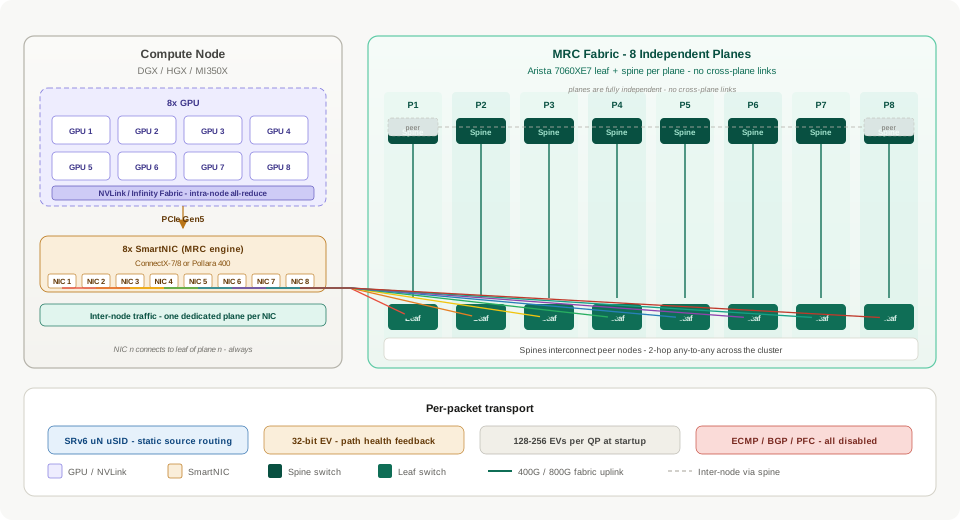
Each plane operates as an isolated 2-hop leaf–spine network. A 72-GPU rack typically pairs nine compute nodes with sixteen Arista 7060XE7 switches — one leaf and one spine per plane — delivering deterministic any-to-any connectivity for collective traffic.
Getting started
Browse the Pages tab for interactive SVG diagrams, or the Reference tab for the glossary and SRv6 configuration guide. Each diagram page is a self-contained reference with legends, callouts, and design notes.